Transactions in Henceforth
Three surfaces, one primitive — from a single tap to a batched eight-recipient settlement to a raw-hex hand-off across an air gap.
Henry Hudson · Henceforth · 2026
1. Background — transactions are data, not events
Satoshi's framing from §2 of the white paper:
A Bitcoin transaction is a chain of digital signatures serialised to bytes. Not an event. Not a message to a service. Just data: structured, signed, self-contained. Any byte channel can carry it — TCP, AirDrop, USB stick, QR code, paper.
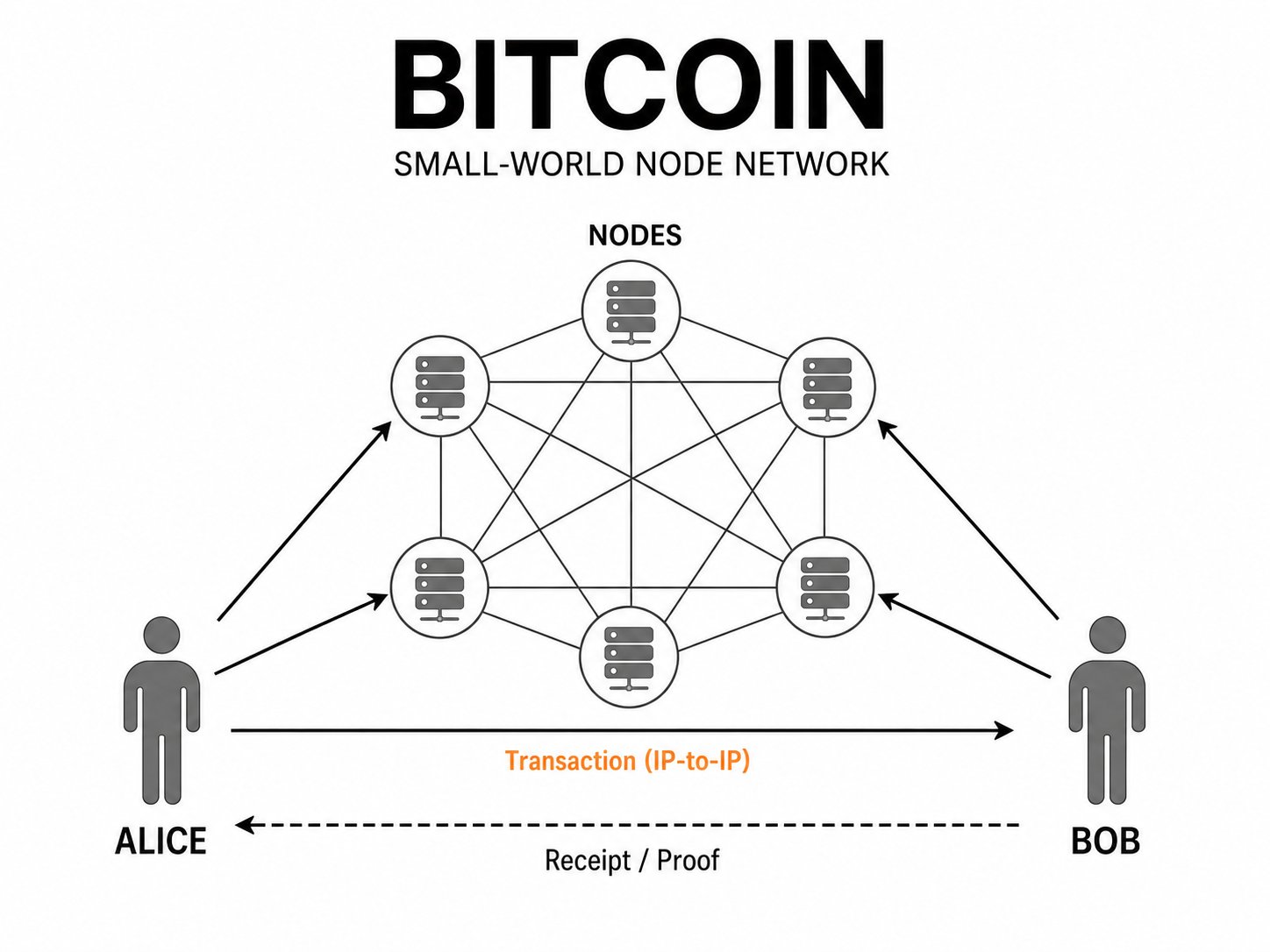
Two consequences fall out:
- Broadcasting is one possible delivery mechanism, not the only one. "Each node broadcasts new transactions to all nodes" (§5) describes a network behaviour, not a hard requirement on the sender.
- The receiver verifies the chain themselves. "The recipient performs a similar check to verify all previous transactions in the chain, satisfying themselves that the chain of ownership is valid" (§2). The sender doesn't have to be online for the verification to happen.
Henceforth surfaces this primitive across three modes — each fitted to a different situation, all producing the same on-wire artefact:
| Surface | Trigger | Best for |
|---|---|---|
| PayView | Tap-to-pay button | One recipient, one amount, one Face ID |
Terminal send / send-many | Stack operation | Programmable batches, defined words, automation |
| Raw transaction popup | Tap the Bitcoin logo at the top of PayView | Air-gap hand-off, peer-to-peer settlement, ad-hoc out-of-band delivery |
The rest of this article walks each surface and the math, atomicity, and architecture that sit under all three.
2. PayView — the simple send
Most payments are one recipient, one amount. PayView is the GUI surface for that case: enter an address (or paymail), enter an amount, confirm. The wallet selects a UTXO, signs the input with the user's private key, constructs the change output back to a freshly-derived Type42 address, and broadcasts via ARC.
Before signing, PayView lays the output set out for the user — recipient, amount, change return, fee. The user approves a labelled batch, not a hash. Approval is one Face ID tap.
3. The Bitcoin logo at the top — raw transactions by hand
The peer-to-peer hand-off works in both directions. Henceforth surfaces a send-side and a receive-side for raw transaction bytes — and a receipt loop that closes the round trip without trusting a third party.
Send side — tap the Bitcoin logo
Above the recipient field on PayView (single sends) and at the top of MultiPaySheet (the send-many review surface), Henceforth shows a small Bitcoin logo. Tapping it opens RawTransactionPopUpView, which renders the constructed transaction's hex in a monospaced block:
01000000019b8a4c7f...8b5f0000000000ffffffff02...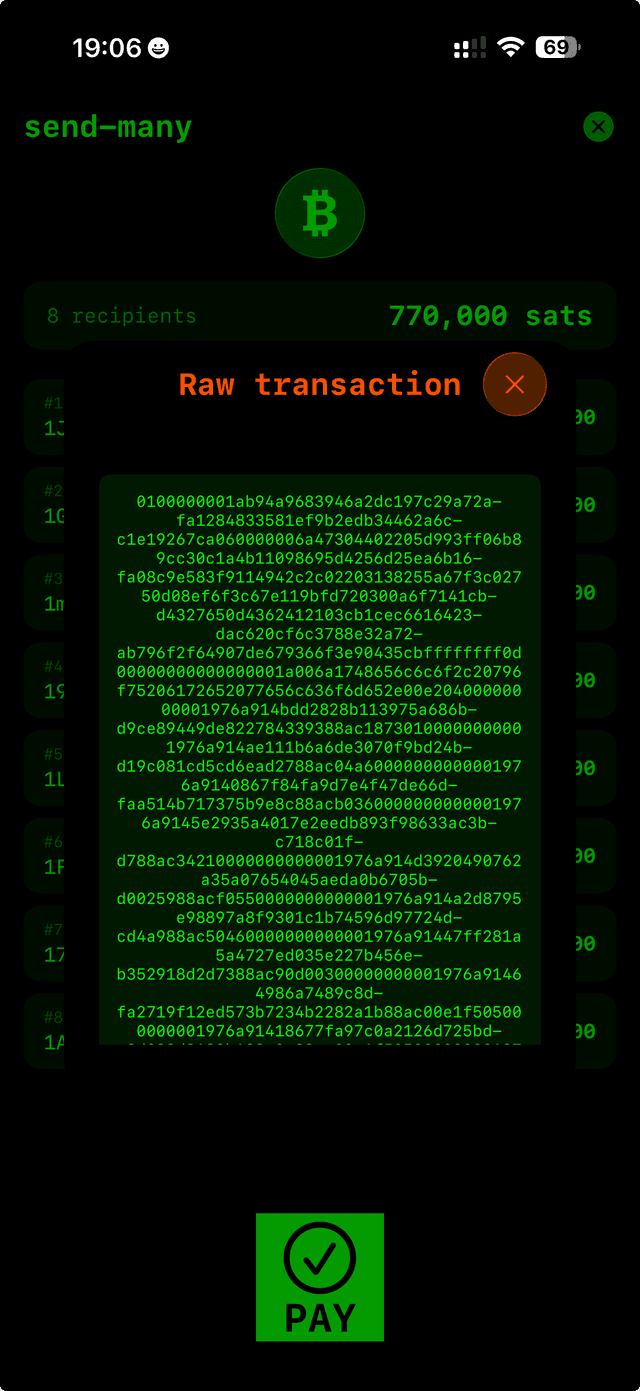
The hex is wrapped in a SwiftUI ShareLink. Tapping the text opens the system share sheet:
- Copy to clipboard
- AirDrop to another device
- Save to Files (becomes a
.txtyou can attach anywhere) - Send via Mail, Messages, or any third-party share-extension target
- Drop into a peer-to-peer messenger
Any channel that can move ASCII can move the transaction.
This is the manual version of the air-gap broadcast pattern that Cold Mode automates. With Cold Mode enabled, transactions go to a Pending Broadcasts queue for later release from a network-connected device. Without Cold Mode, tapping the Bitcoin logo gives the user the same raw artefact inline — useful for ad-hoc out-of-band delivery, for verifying a transaction looks right before broadcast, or for sharing with a counterparty who needs to validate the on-chain shape before settlement.
Receive side — Decode Transaction
Receiving a raw transaction over a side channel is only safe if you can read it before you act on it. Henceforth ships a DecodeTransactionView for exactly that: paste a hex string into a monospaced editor (or tap Paste from clipboard), tap Decode, and a DecodedTransactionSheet renders the parsed transaction — version, locktime, every input with its outpoint and unlocking script, every output with its address and amount, the fee.
The decoder uses SwiftBSV to parse — the same library the wallet uses to build and sign. There is no network call. The decode is a pure local function on bytes the user pastes in.
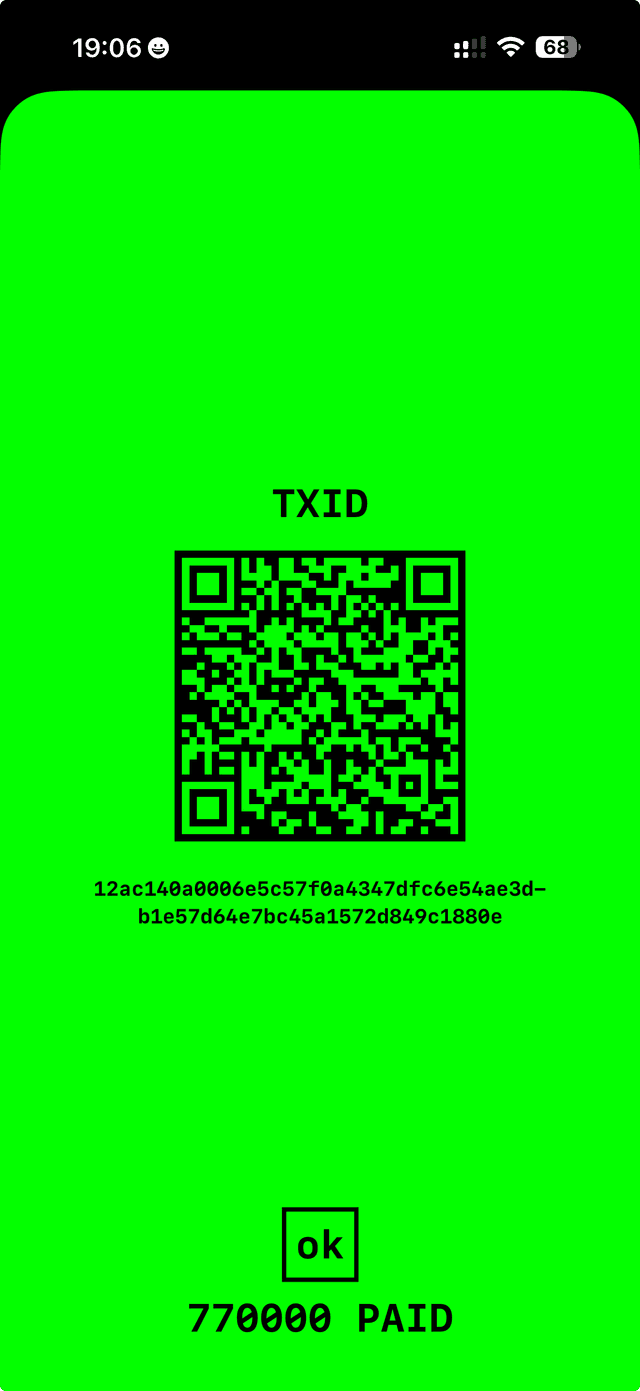
A Broadcast button at the bottom of the decoded sheet commits the transaction directly to ARC (same GorillaPool → TAAL failover the rest of the wallet uses). The txid shown on success is computed locally from the raw bytes — the wallet doesn't need to wait for the API to tell it the txid; it already has all the information it needs from the transaction itself.
Concretely, a recipient who has been handed a raw transaction can:
- Open Settings → Bitcoin → Decode Transaction.
- Paste the hex.
- Inspect the output set — addresses, amounts, totals — before doing anything irreversible.
- Tap Broadcast (or refuse).
The same view is useful for any raw hex the user encounters in the wild — a transaction quoted in a forum post, a block explorer link, a paymail server response. Decode-on-demand is a primitive, not a single-purpose tool.
The receipt loop
What comes back from the broadcaster (or the recipient who chose to broadcast on the sender's behalf) is an HFReceiptBundle — Henceforth's receipt format containing:
- The raw transaction
- The TSC (BRC-74) Merkle proof
- The containing block header
The signer imports the bundle through SPVService.verifyTransaction(fromBundle:), which validates Merkle inclusion against the signer's local header at the same height — no network call, no third-party trust. The bundle's own header is a reference, not a trust source. Decode-time consistency checks (proof.target ≡ blockHash, header.hash ≡ blockHash) catch tampering before the heavier PoW verification runs.
This is the Satoshi loop, materialised:
The receiver verifies the chain. The sender doesn't have to be online for the verification to happen. The transaction is just data — and so is the receipt.
Wright's 2026 paper, Batching, Headers, and Throughput, presses this further into a full operating model. An air-gapped signer can never see the chain directly, so it must receive headers (HFHeaderBundle) and receipts (HFReceiptBundle) from an online watcher — passed across an explicit boundary. Henceforth ships both bundle formats; the Settings → Bitcoin → Air-Gap Tools UI surfaces export/import for each, routed by .hf* file extension and reachable via the system share sheet (AirDrop included).
The Bitcoin-logo tap is the ergonomic, single-payment version of the same architecture. You don't have to flip Cold Mode on; you don't have to be in the Air-Gap Tools panel. You're already in PayView, you've already built the transaction — the raw hex is one tap away.
4. Terminal send — the programmable single
The terminal exposes the same single-recipient send as a stack operation:
14000 s" 1Cof...p3J" sendsend takes an amount and a counted address string and routes the payment through PayView — the user still reviews outputs before Face ID, the wallet still constructs change against a fresh address, ARC still broadcasts. The difference is that the call composes.
Two recipients at the same amount, in one transaction:
14000 s" 1Cof...p3J 1Cof2...q4K" sendPass a space-separated address string and send splits the amount equally across all recipients. Same single-Face-ID approval, same atomic delivery, one transaction on chain.
5. Terminal send-many — N amounts to N addresses
When each recipient takes a different amount, send-many is the right word. Amounts go on the stack first, address string last:
320000 95000 42500 14000 8500 22000 18000 250000
s" 1Land...kqW 1Groc...xR2 1Util...mB7 1Cof...p3J
   1News...t9K 1Gym...sV4 1Strm...e6W 1Cold...zY1"
send-many
The word reads the address string first to derive N (eight, in this case), then pops exactly N amounts beneath it. The address string declares N implicitly — no redundant count parameter that could disagree with the address list.
A successful invocation consumes the entire stack contribution and leaves no residue. If any validation step fails (one bad address, one zero amount, total exceeding wallet balance), the entire stack is restored to its pre-call state. The user can inspect, correct the input, and retry.
6. The mathematics of overhead
Section 7 of the white paper is conservative on output count:
At most two. The phrasing described 2008's dominant case but was never a protocol limit. Bitcoin transactions accept an arbitrary number of outputs subject only to the standard maximum transaction size.
Henceforth carries the per-byte costs as named constants:
p2pkhInputSize   = 148    // input + signature + pubkey + index
p2pkhOutputSize  = 34     // value + script-length + P2PKH script
txOverheadSize   = 10     // version + locktime + counters
A 1-input, N-output transaction: 192 + 34N bytes.
N separate single-payment transactions: 226N bytes.
At N = 8 recipients:
| Single tx, 8 outputs | Eight separate txs | Ratio | |
|---|---|---|---|
| Wire bytes | 464 | 1,808 | 0.26× |
| Fee at 0.05 sat/byte | 24 sats | 91 sats | 0.26× |
| ARC submissions | 1 | 8 | 0.125× |
| Biometric prompts | 1 | 8 | 0.125× |
| Mempool entries | 1 | 8 | 0.125× |
| Atomicity | all-or-nothing | per-payment | — |
For payments dominated by economically large transfers — rent, mortgage, salary — a 67-satoshi fee difference is irrelevant. For micropayments, where individual amounts may themselves be in the low thousands of satoshis, paying four times the fee to avoid batching is the difference between economical and uneconomical workflows.
7. Atomicity is the underrated property
The fee saving is the easy headline. The structural benefit is that the eight payments either all happen or none do.
A freelancer running their weekly-bills word cannot end up with rent paid and groceries unpaid because of an intermittent ARC failure between the second and third submissions — there is no second submission. ARC accepts the 464-byte transaction or rejects it; either way the state of all eight payments is known with one confirmation.
The structural savings compound:
- One biometric prompt — not eight authentications for what is conceptually one decision.
- One ARC submission — one round trip; if GorillaPool fails, one failover to TAAL — not eight.
- One mempool entry — the eight payments are seen by the network together, settled together, confirmed together.
- One line in transaction history — "Friday bills: 770,000 sats, 8 recipients" instead of eight near-simultaneous outgoing entries the user has to mentally re-group.
From the network's perspective, the freelancer paid 770,000 satoshis from one input to eight payees, with change returned to themselves. Every recipient sees a normal P2PKH output addressed to them, indistinguishable from a single-purpose payment.
There's a security argument adjacent to atomicity. One signed bundle of eight payments is one biometric prompt, one Keychain access, one signing event — a smaller attack surface than eight independent signing sessions. Wright's §XII frames it directly: fewer events, fewer opportunities for error. The atomicity property and the reduced-attack-surface property come from the same underlying fact — eight outputs in one transaction is one operation, not eight near-simultaneous ones.
8. Why this belongs in a terminal
A graphical UI for "pay eight recipients in one transaction" is not impossible — it just requires a custom screen, a custom data entry pattern, and a custom approval flow, all of which are downstream of someone deciding that batched payment is a feature worth UI investment.
Henceforth's terminal makes the same operation a one-liner without any of that downstream design work. Picture a freelancer's Friday — eight regular outflows that need to happen, in BSV:
| Recipient | Address (truncated) | Amount (sats) |
|---|---|---|
| Landlord (weekly rent share) | 1Land...kqW | 320,000 |
| Groceries (corner store paymail) | 1Groc...xR2 | 95,000 |
| Electricity + internet | 1Util...mB7 | 42,500 |
| Coffee subscription | 1Cof...p3J | 14,000 |
| Newspaper (digital, weekly) | 1News...t9K | 8,500 |
| Gym (off-peak) | 1Gym...sV4 | 22,000 |
| Streaming bundle | 1Strm...e6W | 18,000 |
| Cold wallet (weekly auto-savings) | 1Cold...zY1 | 250,000 |
| Total | 770,000 |
Eight payments to eight different recipients. In an ordinary wallet that's eight pay-screen sessions, eight Face ID taps, eight ARC submissions. In Henceforth it's one defined FORTH word that composes the whole routine into a single token:
: weekly-bills ( -- )
  320000 95000 42500 14000 8500 22000 18000 250000
  s" 1Land...kqW 1Groc...xR2 1Util...mB7 1Cof...p3J
     1News...t9K 1Gym...sV4 1Strm...e6W 1Cold...zY1"
  send-many ;

> weekly-bills
Confirm send-many to 8 recipients (770,000 sats)
ok.
The user has defined a personal word, weekly-bills, that captures their weekly payment routine in a single token. Running it costs one biometric tap. Editing it is editing the word's body. Saving the definition in a .fs file makes it portable across devices.
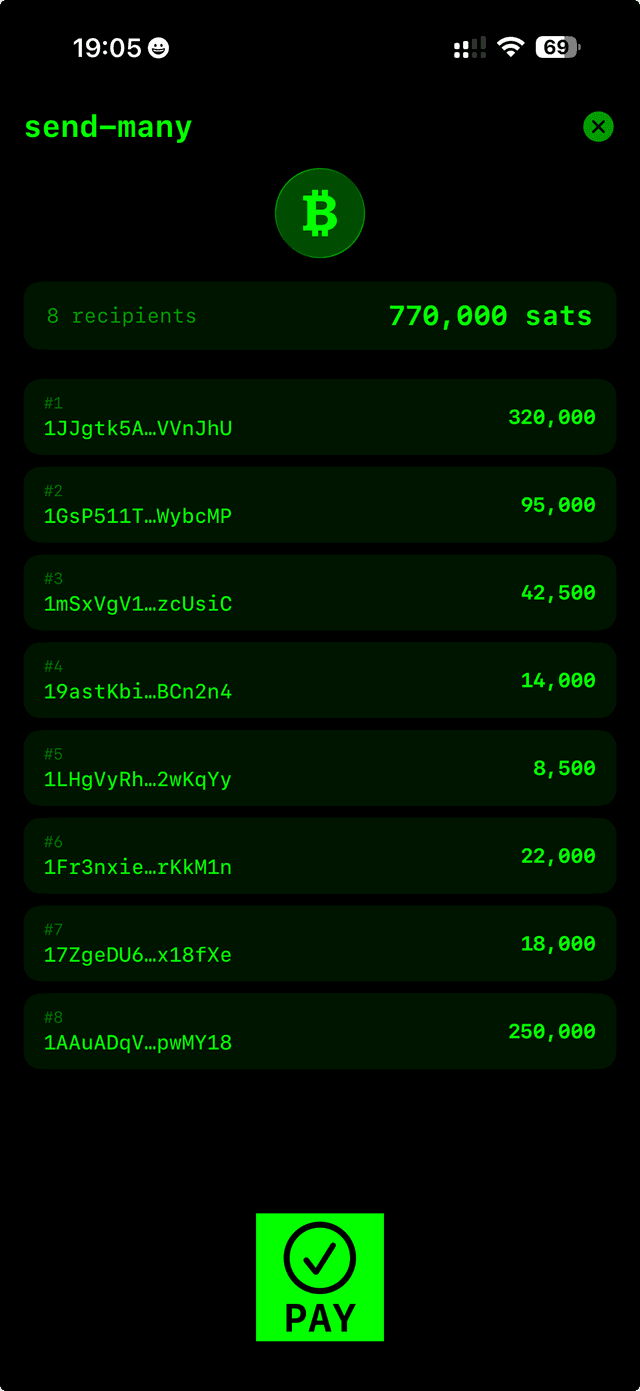
Multi-output sending is not a feature that has to be added to a UI. It is what falls out of treating the payment primitive as a stack operation.
9. The other half — receiving at scale
The send-side argument has a receive-side mirror. Every inbound payment is a new UTXO; every freshly-derived receive address (Type42 rotation, the BRC-42 privacy story) means the wallet's UTXO set grows by one entry per payment received. A wallet that receives payments at any reasonable cadence — donations, payroll, micropayment subscriptions, royalty splits — accumulates hundreds or thousands of inputs over a year.
Wright's framing in §V: fragmentation is the structural consequence of the receive-side strategy that the privacy and accounting story demands. You can't have fresh addresses without UTXO accumulation. The two problems are entangled, and a wallet that ignores either half eventually fails on the other.
Henceforth handles consolidation two ways. Most of the time, normal sends consolidate as a side effect. Wallet.selectUTXOs switches above 100 UTXOs into a fragmentation-aware mode — smallest-first phase, raised dust cap — so an ordinary send pays the recipient and drains the dust pile in the same transaction. The user initiates a payment; the wallet quietly cleans up the inputs as part of building it.
When the user wants to consolidate proactively — say, after a long receive-only period, or before a known large outflow — the Consolidate action in the UTXO detail view assembles a self-transfer that merges many small inputs into one large output. The on-chain shape is the geometric mirror of send-many: many inputs, one or two outputs. Same protocol primitive, opposite direction.
The receive-side story has a watch-only half too. The signer derives its own receive addresses (no network needed for derivation); but the wallet needs to know when those addresses receive funds. HFAddressPack is the signed export of a derived address list — the signer hands it across the air-gap to an online watcher, the watcher monitors the mempool and chain, and notifies the signer (via the same HFReceiptBundle path the receipt loop in §3 uses) when payments land. Same two-machine architecture, reverse direction.
The send side and the receive side cannot be separated. A wallet that doesn't batch its outgoing payments will fragment its inputs faster than the receive side can compensate. A wallet that batches outputs but never consolidates inputs will fail differently — bigger transactions, worse fees per byte, eventually transactions that exceed the standard relay size. Henceforth implements both halves because Wright's framing makes the cost of skipping either half explicit.
10. The wider context
Batching, Headers, and Throughput frames a high-volume wallet as a system of components, none removable without loss: offline signer, header sync, watch-only monitoring, batching, consolidation, fresh-address strategy, and a non-negotiable pre-signing verification step. Henceforth's current mapping against Wright's architecture:
- Offline signer —
WalletCard.coldModeEnabled+ Pending Broadcasts. The signer never goes online; the watcher broadcasts. - Header-based blockchain awareness —
HeaderSyncService+SPVCheckpoint. SPV against block headers, not network calls to a trusted node. - Offline header transfer —
HFHeaderBundle. The watcher exports headers as a signed bundle; the signer imports them through the samecommitValidatedHeaderRunpath that validates online sync. - Merkle-proof export for offline verify —
HFReceiptBundle. The receipt-back flow described in §3 above. - Watch-only address monitoring —
HFAddressPack+MempoolMonitorService. Partial in v1.0: the signer exports a signed address-pack and the watcher decodes and validates it, but the watcher does not yet persist the addresses into a monitoring store wired toMempoolMonitorService. v1.1 closes the loop. - Batching on the send side —
send-many. - Consolidation on the receive side —
ConsolidateUTXO, plus a fragmentation-aware UTXO selection policy that drains the dust pile as a side effect of normal sends (see §9). - Fresh address per payment — Type42 (BRC-42) rotation, automatic post-transaction.
- Pre-signing verification —
PayView/MultiPaySheetpresent the output set before Face ID on every send. Partial in v1.0:TransactionReviewViewis the canonical byte-level review surface (inputs + outputs + fee) but is currently wired into the BRC-100 pending-broadcast queue, not yet hoisted as an overlay over the active PayView / MultiPaySheet path. The surface exists and is tested; the residual is the routing decision.
The send side and the receive side are inseparable, and the article's argument is structural rather than incremental — Wright's framing forces both halves to be implemented, and Henceforth's v1.0 ships seven of nine components fully and two in honest partial state.
11. Closing
Three observations from shipping this.
The two-output convention is sticky. Every wallet that exposes only a single-recipient pay screen silently asserts that the two-output case is the unit of payment. For genuinely one-to-one workflows, fine. For weekly bills, payroll, micropayment distributions, royalty splits, multi-party settlements — the convention costs real fees and forces users to manually orchestrate what the protocol already supports atomically.
Atomicity is the underrated property. The fee headline is easy. The practical user-facing benefit is that the payments either all happen or none do.
Transactions are data, not events. Tapping the Bitcoin logo in PayView surfaces the raw hex. AirDrop it, paste it, paper-print it, hand it over. The receipt comes back as a Merkle proof against the receiver's local headers. The transaction itself is just bytes — Satoshi said this in 2008, Wright reasserts it for the high-volume case, and Henceforth implements it as the default surface rather than a buried air-gap feature.
References
- Satoshi Nakamoto, Bitcoin: A Peer-to-Peer Electronic Cash System, 2008. §2 (chain of digital signatures), §5 (network broadcast), §7 (combining and splitting value).
- Craig Wright (@CsTominaga), Batching, Headers, and Throughput: Operating a Bitcoin SV Wallet with Offline Synchronisation and High-Volume Microtransactions, Craig's Substack, May 2026.
Henceforth on iOS & macOS: apps.apple.com/app/henceforth
— Henry Hudson · @henceforth_app